
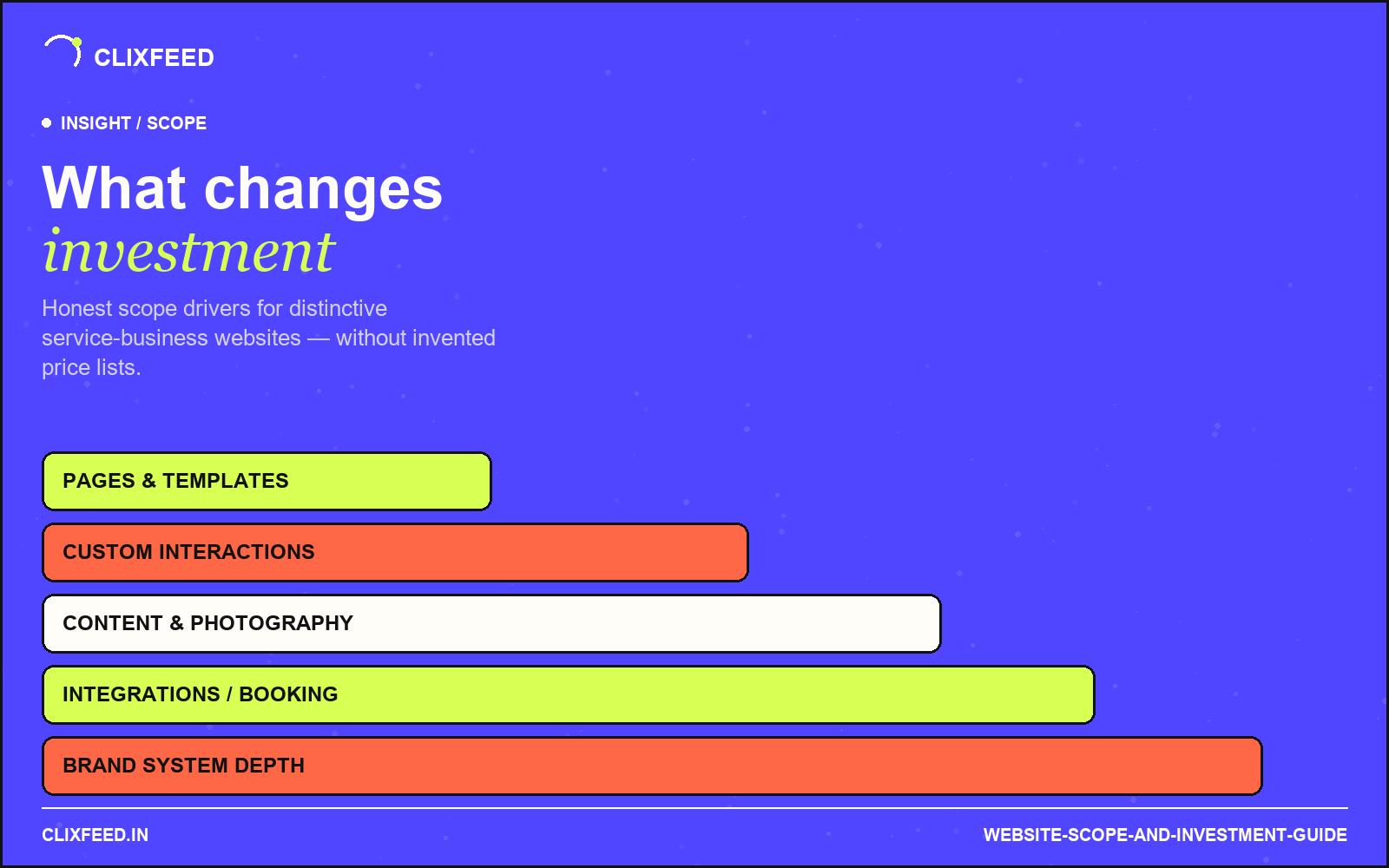
The baseline assumption.
ClixFeed does not publish a universal price list because honest pricing depends on what the site must do, what you already have, and how many decision-makers are in the room. A typical engagement is a distinctive, conversion-minded marketing website for a service business — not a custom web application, not unlimited content production, not an open-ended brand consultancy.
- Strategic alignmentAudience, offer, and the one primary action the site exists to drive.
- Responsive design and buildEvery agreed page designed and built for phone, tablet, and desktop.
- Performance and accessibility disciplineCore budgets, semantic markup, keyboard paths, reduced-motion support.
- Launch-ready handoffForms tested, analytics live, policies linked, documented walkthrough.
Number and type of pages.
- Single landing page or compact site
- Home, services, about, contact
- One or two supporting pages
- Multi-service architecture
- Location pages and resource library
- Campaign microsites and member areas
- Extensive FAQ or policy pages
- Multiple audience paths
Each page is not a template duplicate. Unique page goals mean unique layout decisions, copy structure, proof placement, and mobile behaviour.
Launch with the smallest set that supports your primary action. Add pages when you have traffic, proof, and content — not 'just in case'.
Content readiness.
- You provide final copy
- Photography, logos, service definitions supplied
- We structure, edit lightly, design around real material
- Copy must be written from interviews or bullet notes
- Photography must be art-directed or sourced
- Multiple stakeholders produce conflicting inputs
Content delay is the most common timeline risk. Writing and asset production are specialised work — they expand scope when they sit with the studio instead of the client.
Prepare copy and imagery before design starts, or budget separately for copywriting and photography coordination.
Integrations and functionality.
- Contact form to email or simple form service
- Embedded map and social links
- Analytics baseline, downloadable PDF
- CRM integration and marketing automation
- Live scheduling and payment deposits
- Membership login and multi-step qualification flows
- Calculators and custom API connections
- Multilingual CMS workflows
Integrations add discovery, testing, failure handling, and ongoing dependency on third-party tools. A beautiful booking UI that connects to your practice software is a different project than a demonstration form.
Phase one: prove the conversion path with a reliable minimum integration. Phase two: deepen automation once the core site earns its keep.
Motion and interaction.
- Purposeful scroll behaviour
- Hover states and accessible transitions
- Occasional reveal with reduced-motion fallback
- Configurators and draggable comparisons
- Spatial viewers and quiz logic
- Campaign-specific experiential sections
- Choreographed video-led storytelling
Interaction design, prototyping, and performance optimisation take focused time. Motion should earn its place — decorative animation across every block multiplies build and test time.
Choose one signature interaction that supports the offer. Default the rest to clarity and speed.
Brand and visual system work.
- Existing brand applied consistently
- Logo, colours, fonts, basic components
- Brand refresh and new typography system
- Illustration set and iconography
- Photography direction and social templates
- Print alignment and sub-brand territories
A website is where brand rules become interactive reality. If the rules do not exist yet, they must be created before pages multiply.
Separate 'enough to launch well' from 'complete brand universe'. Launch the site when the digital system is coherent; extend the brand after.
Revisions and stakeholder complexity.
- One clear decision-maker
- Timely feedback, consolidated rounds
- Committee approvals
- Legal or clinical review on every page
- Brand police plus external agency
- Parallel opinions that reverse earlier decisions
Revision rounds are not unlimited by default. Each additional cycle touches layout, copy, responsive behaviour, and QA. Stakeholder sprawl is a scope multiplier even when page count stays flat.
Assign one approver. Batch feedback. Resolve positioning before pixel-pushing.
Platform and handoff expectations.
- Static or lightly CMS-backed site
- Documented handoff
- Client can update agreed areas
- Complex CMS training and component library
- Design system documentation
- Ongoing retainer
- Migration from legacy platform with hundreds of URLs
What happens after launch is part of the build decision. A site you cannot maintain becomes stale — and then you rebuild again.
Decide who owns updates on day one. If nobody will, buy a retainer rather than a CMS nobody uses.
What does not automatically belong in scope.
Unless explicitly named in the proposal, these sit outside a website engagement. Naming them protects both sides — and stops a quote comparison that is not comparing like for like.
- SEO retainers and content marketing programmes
- Paid ad creative and media buying
- Professional photography and video production
- Legal, medical, or financial compliance sign-off
- Copywriting for entire libraries of blog posts
- Custom software products, marketplaces, or native apps
- Guaranteed business outcomesEnquiries depend on offer, market, and traffic — not design alone.
How to read a proposal.
When comparing studios, ask the same six questions of each. A cheaper quote that excludes integrations, copy, or mobile QA is not cheaper. It is incomplete.
- Page list
Named pages — not "up to ten pages".
- Content assumptions
Who writes? Who supplies photography?
- Integration list
Specific tools, and live versus demo behaviour.
- Revision policy
Rounds, response windows, and what counts as new scope.
- Launch definition
Domain, analytics, forms tested, policies linked.
- Exclusions
Equally as important as the inclusions.
Good fit and poor fit.
We would rather decline than deliver something generic under false pretences. This is the line we hold.
- You have a real offer and can explain who it is for
- You value distinction and clarity over template speed
- You can provide timely feedback and assets
- You know the primary action the site should drive
- You want a focused marketing website, not a software product
- The offer is undefined and you expect the studio to invent the business model
- You need fabricated proof or misleading claims
- Decision-making is permanently stalled across many stakeholders
- You only need the lowest-cost execution of an existing template
- You expect design alone to fix a broken offer or no demand
Send this, not a one-line brief.
Five answers turn a quote request into a real scope conversation — and cut the back-and-forth by about a week.
- Your primary business goal for the site
Enquiries, bookings, qualified leads, recruitment — pick one.
- A rough page list or sitemap sketch
A napkin photo is fine. We will challenge it.
- What you already have
Brand, copy, photography, integrations, domain access.
- Your target timeline
Including any immovable date — launch, event, season.
- Two or three references you admire — and why
"The way they handle proof" is more useful than a URL.
ClixFeed will respond with clarifying questions and a scope outline that reflects what the project actually needs. Distinctive by design. Commercial by default.